Why This Matters
Rate limiting is a critical security control. When it fails, your API becomes vulnerable to abuse, credential stuffing, and denial of service attacks. But implementing it correctly is harder than it looks—especially when concurrent requests are involved.
I discovered this the hard way when my “working” rate limiter let through unlimited requests under load.
The Hidden Vulnerability
The original implementation looked reasonable:
async function checkRateLimit(userId: string): Promise<boolean> {
  const limits = loadRateLimits();           // 1. Read current state

  if (limits[userId] >= MAX_REQUESTS) {
    return false;                             // 2. Check limit
  }

  limits[userId] = (limits[userId] || 0) + 1; // 3. Increment
  saveRateLimits(limits);                     // 4. Write back

  return true;
}
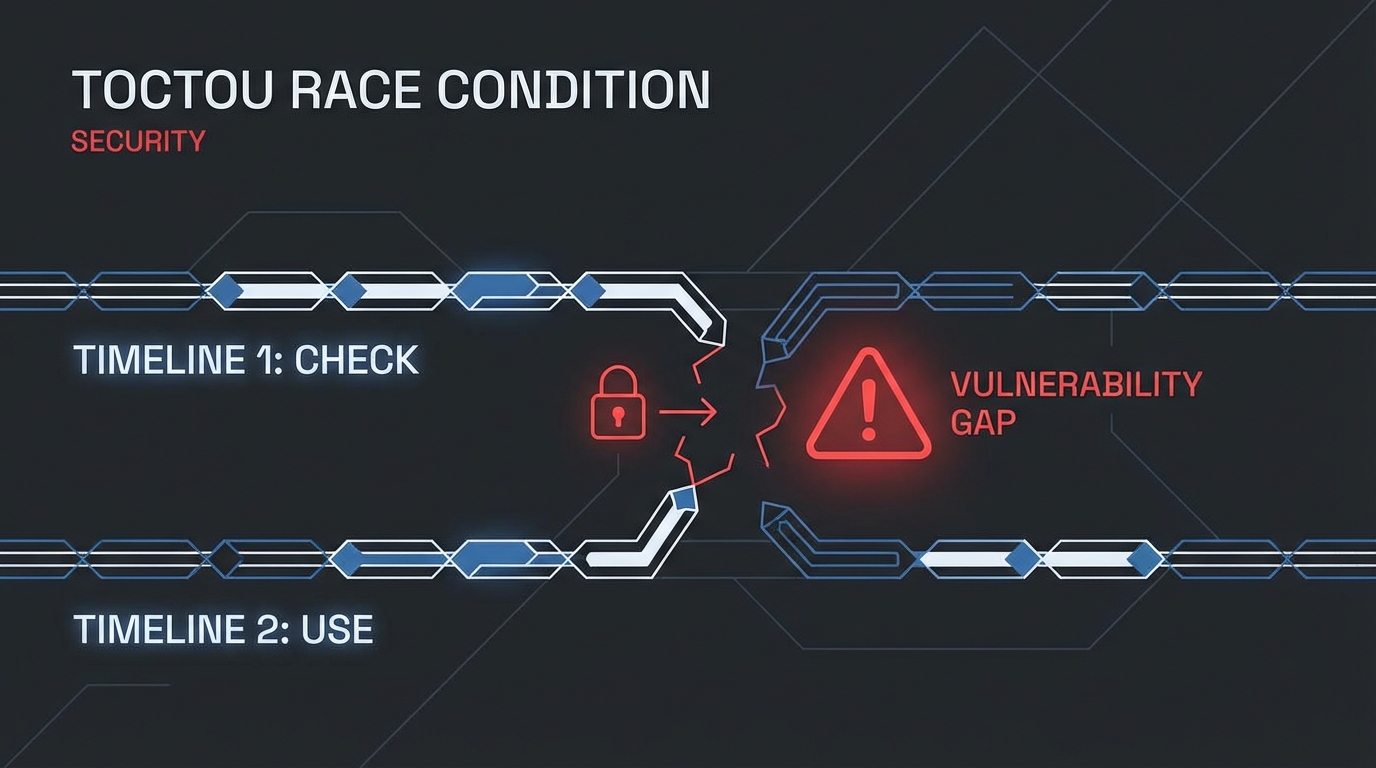
The problem? TOCTOU (Time-of-Check to Time-of-Use).
Between reading the current count (step 1) and writing the new count (step 4), another request can slip through:
Time →
Process A: Read(count=99) → Check(OK) → Increment → Write(100)
Process B:      Read(count=99) → Check(OK) → Increment → Write(100)
Process C:           Read(count=99) → Check(OK) → Increment → Write(100)
All three processes read count=99, all pass the check, and all write count=100. Three requests go through when only one should.
The Solution: Atomic Operations
The fix requires making the read-modify-write operation atomic. No other process can access the state between our read and write:
import { Mutex } from 'async-mutex';

const rateLimitMutex = new Mutex();

async function checkRateLimit(userId: string): Promise<boolean> {
  return rateLimitMutex.runExclusive(async () => {
    const limits = loadRateLimits();

    if (limits[userId] >= MAX_REQUESTS) {
      return false;
    }

    limits[userId] = (limits[userId] || 0) + 1;
    saveRateLimits(limits);

    return true;
  });
}
Now requests are serialized:
Time →
Process A: [LOCK] Read → Check → Increment → Write [UNLOCK]
Process B:                                           [LOCK] Read → Check(FAIL!) [UNLOCK]
Better Alternatives
For production systems, consider:
Redis with atomic increment:
INCRis inherently atomicconst count = await redis.incr(`rate:${userId}`); await redis.expire(`rate:${userId}`, WINDOW_SECONDS); return count <= MAX_REQUESTS;Database constraints: Let the database handle atomicity
UPDATE rate_limits
SET count = count + 1
WHERE user_id = ? AND count < 100;
-- Check affected rows to determine if allowed
Token bucket with atomic operations: More sophisticated rate limiting with burst allowance
Lessons Learned
- File-based state is dangerous for concurrent access - Always assume multiple processes are running
- “Read, check, modify, write” is a red flag - Look for TOCTOU vulnerabilities
- Test with concurrency - A single-threaded test won’t catch race conditions
- Security code needs security review - Include race condition analysis in threat modeling
The vulnerability was subtle—the code worked perfectly in development but failed under production load. Race conditions are timing-dependent demons that only appear when you’re not looking.
Prevention Checklist
Before deploying rate limiting:
- Is the increment operation atomic?
- Tested with concurrent requests (
ab,wrk, or parallel curl)? - Considered using a proper data store (Redis, database)?
- Reviewed for other TOCTOU patterns in the codebase?
Your rate limiter is only as strong as its weakest concurrent access point.