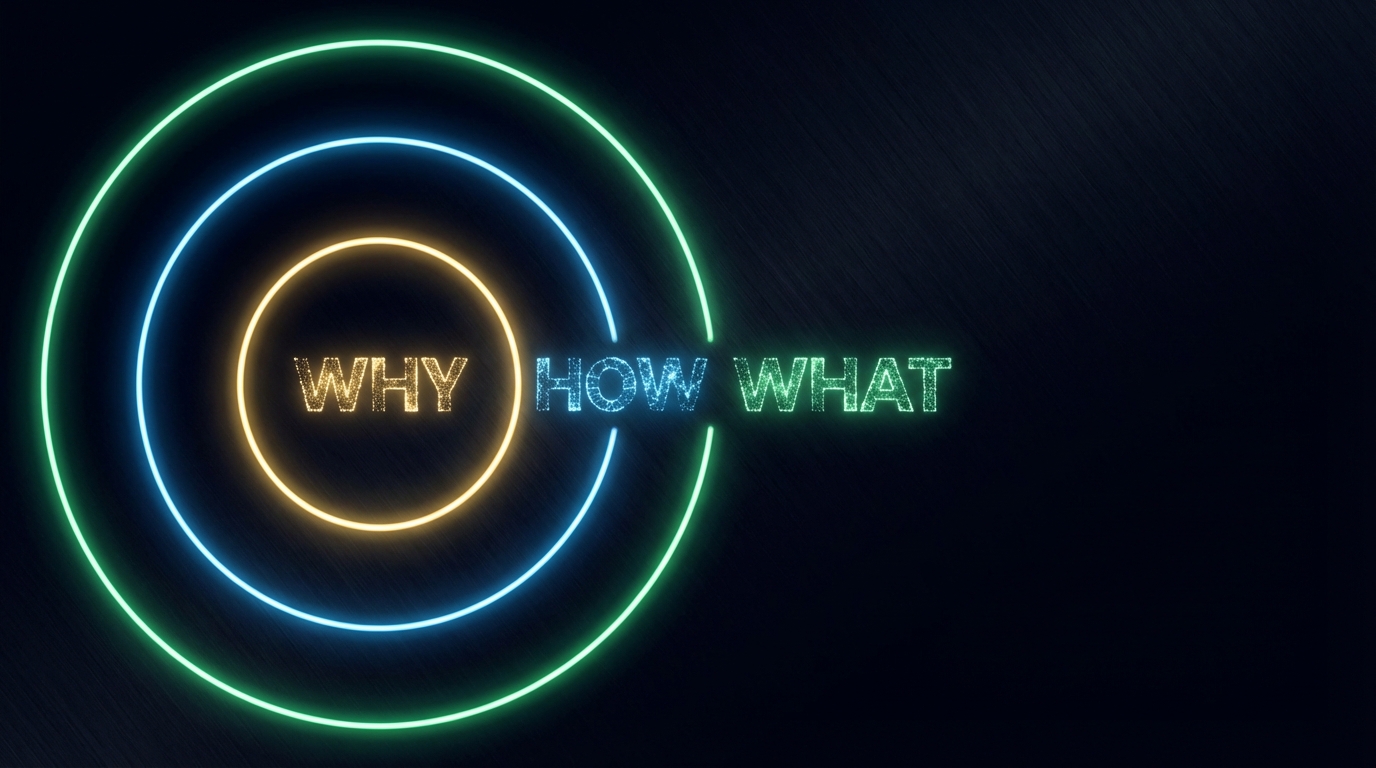
WHY: The Documentation Trap
Most technical blog posts fall into what I call the “Documentation Trap.” They read like a README file:
- Here is the library I used.
- Here is the code I wrote.
- Here is how you run it.
While this information is useful, it’s rarely engaging. As developers, we are trained to focus on the WHAT—the specific implementation details, the syntax, the tools. But as human beings, we are wired for stories. We don’t just want to know what you built; we want to know why you bothered to build it in the first place.
When a blog post is purely WHAT-heavy, it lacks a narrative hook. Readers might skim the code, but they won’t remember the lesson. To create content that resonates and sticks, we need to flip the script.
HOW: Reframing with the Golden Circle
In his famous TED talk, Simon Sinek introduced the “Golden Circle”—a framework for leadership and communication that starts with WHY, then moves to HOW, and finally to WHAT.
Applying this to technical writing transforms a dry tutorial into a compelling narrative:
- WHY (The Emotional Hook): Start with the pain point. What was the problem that kept you up at night? Why did the existing solutions fail? This is where you connect with the reader’s own frustrations.
- HOW (The Philosophy/Approach): Explain the principles you applied to solve the problem. This isn’t about code yet; it’s about your mental model, your architecture, and your decision-making process.
- WHAT (The Implementation): Finally, show the specific code, tools, and steps. Because the reader now understands the why and the how, the what becomes much more meaningful.
The Narrative Arc
graph LR
    A[WHY: The Pain] --> B[HOW: The Strategy]
    B --> C[WHAT: The Solution]
    C --> D[Result: Transformation]
By following this arc, you aren’t just teaching a skill; you’re sharing a journey.
WHAT: A Before and After Comparison
Let’s look at how a typical post about “Setting up a Redis Cache” might be transformed.
The “WHAT-First” Approach (Traditional)
Title: How to use Redis with Node.js “In this post, I’ll show you how to install Redis and use the
ioredislibrary to cache API responses. First, runnpm install ioredis…”
The “WHY-First” Approach (Golden Circle)
Title: Why Your API is Slow (and How Redis Can Save It) “WHY: Last week, our production server crashed because of a sudden spike in database queries. We realized that 80% of those queries were for the same static data. It was a waste of resources and a terrible user experience. HOW: We decided to implement a ‘Cache-Aside’ pattern. The goal wasn’t just to add a database, but to create a layer of ‘fast-access memory’ that sits between our users and our expensive database operations. WHAT: Here is how we implemented the
ioredisclient to handle this…”
Conclusion: Writing for Humans, Not Just Compilers
The Golden Circle structure works because it mirrors how the human brain processes information. We connect emotionally first (the limbic system), then we rationalize (the neocortex).
When you start with WHY, you give your readers a reason to care. When you explain the HOW, you give them a mental framework to understand. And when you finally show the WHAT, you give them the tools to take action.
Next time you sit down to write a technical post, don’t start with the code. Start with the reason the code exists.