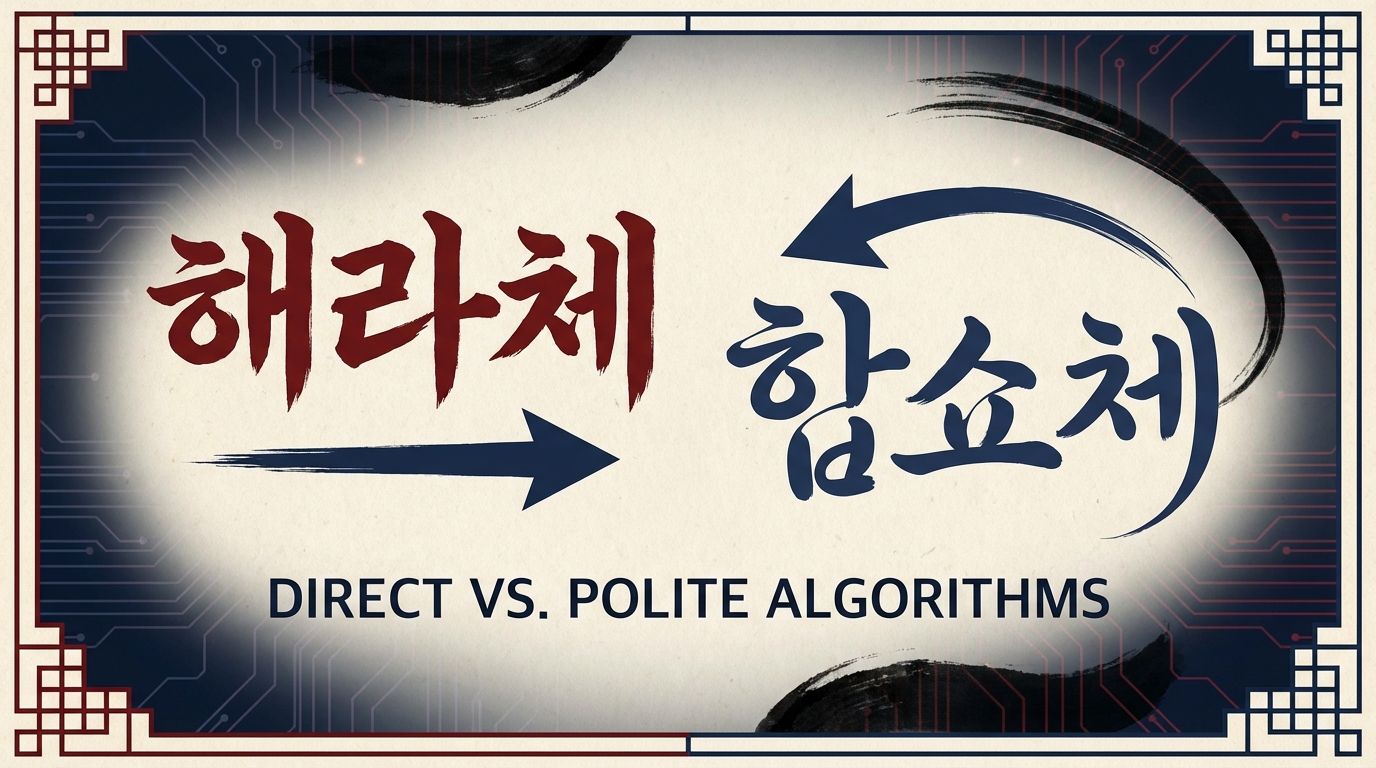
Korean Speech Levels: A Quick Primer
Korean has multiple speech levels that encode formality and social relationship. Two common ones in writing:
Haeyo-che (polite): Ends in ~요
- “이것은 중요합니다” (This is important)
- Feels: Polite, formal, distant
Haerache (plain/declarative): Ends in ~다/~이다
- “이것은 중요하다” (This is important)
- Feels: Direct, authoritative, academic
The Problem with Haeyo-che in Tech Blogs
When AI generates Korean translations, it defaults to haeyo-che (polite form). Every sentence ends in ~요:
이 함수는 문자열을 반환해요.
설정 파일을 수정해야 해요.
결과를 확인해 보세요.
This feels wrong for technical writing. Here’s why:
Too Much Distance
Haeyo-che creates emotional distance. It’s the style you use with strangers, customers, or senior colleagues. Technical content shouldn’t feel like customer service.
Inconsistent Tone
Korean tech documentation, academic papers, and serious blogs use haerache. Haeyo-che creates a tonal mismatch with the broader ecosystem.
Unnecessary Length
Haeyo-che adds syllables to every sentence. In dense technical writing, this overhead compounds.
The Haerache Solution
The same content in haerache:
이 함수는 문자열을 반환한다.
설정 파일을 수정해야 한다.
결과를 확인해 보라.
flowchart LR
    subgraph HAEYO["Haeyo-che (~요)"]
        H1["Polite"]
        H2["Formal"]
        H3["Distant"]
        H4["Customer service tone"]
    end

    subgraph HAERA["Haerache (~다)"]
        R1["Direct"]
        R2["Authoritative"]
        R3["Academic"]
        R4["Documentation tone"]
    end

    HAEYO -->|"Better for"| C1["Casual chat\nCustomer support\nSocial media"]
    HAERA -->|"Better for"| C2["Tech blogs\nDocumentation\nAcademic writing"]

    style HAERA fill:#22c55e,color:#000
This feels like:
- Wikipedia articles
- Technical documentation
- Academic papers
- Authoritative blog posts
Examples in Context
Haeyo-che (Too Polite)
## 설치 방법

먼저 저장소를 클론해요.

```bash
git clone https://github.com/example/repo.git
다음으로 의존성을 설치해요.
### Haerache (Appropriate)

```markdown
## 설치 방법

먼저 저장소를 클론한다.

```bash
git clone https://github.com/example/repo.git
다음으로 의존성을 설치한다.
The second version reads like documentation should read: clear, direct, informative.

## When to Use Each Style

| Context | Recommended Style |
|---------|-------------------|
| Tech blog posts | Haerache (~다) |
| Documentation | Haerache (~다) |
| Academic writing | Haerache (~다) |
| Casual blog | Either |
| Social media | Haeyo-che (~요) |
| Customer support | Haeyo-che (~요) |
| Chat messages | Haeyo-che (~요) |

## Configuring AI for Haerache

When generating Korean content, be explicit:
Write in Korean using haerache style (해라체). Use ~다/~이다 endings, NOT ~요 endings.
Examples of correct style:
- “함수를 호출한다” (O)
- “함수를 호출해요” (X)
Most AI models default to haeyo-che because it's "safer" (more polite). You need to explicitly request haerache.

## Key Takeaways

1. **Korean has multiple speech levels** - Choice affects perceived tone
2. **Haeyo-che feels too polite for tech writing** - Creates unnecessary distance
3. **Haerache matches documentation conventions** - Reads like Wikipedia, not customer service
4. **Be explicit with AI** - Default is haeyo-che; you must request haerache
5. **Consistency matters** - Pick one style and stick with it throughout

The difference seems subtle to non-Korean speakers, but native readers immediately notice. Wrong speech level is like writing a technical manual in the style of a text message - technically comprehensible but tonally jarring.

---

*This style guide emerged from reviewing AI-generated Korean translations that consistently used overly polite haeyo-che. Switching to haerache made the content feel native rather than translated.*